You are currently browsing the category archive for the 'Web 2.0' category.

Guy Kawasaki’s new venture Alltop collects popular Blogs and categorizes them. It makes it very easy to stay up to date on a wide area of topics like Social Media, Marketing, Enterprise IT, Food and Wine (some of my favorites).

Yesterday Alltop launched the category Rich Internet Applications. It includes great resources on RIA and specifically Flex and AIR development, like the blogs from Ryan Stewart, Mike Chambers and Peter Ent. Check it out!

P.S.: Yes, this humble little Blog is included as well.

Wordl is a nifty tool to create word clouds from text or del.ici.ous tags. Here is my del.ici.ous cloud…

Just found this good article on ReadWriteWeb about Flex and AIR usage for enterprise applications. Specifically interesting since I have been pushing this topic for the last 3 years with a special focus on the SAP ecosystem. Today there are many companies using Flex and/or AIR to make enterprise apps user friendly and engaging (Philips, Fender, SAP and many more) and that number is rising fast. With SAP’s announcement to enable embedding of Flex applications in their WebDynpro UI framework we will see a further surge of Flex adoption in the enterprise. To learn more visit SAP TechEd this year. I will be there.

read more | digg story

In case you have not seen it yet. This brilliant YouTube Video makes the round today in the Blogosphere. It is so funny because it’s true (like Dilbert). Also thought this is a perfect fit for my Blog theme “Straight out of Palo Alto”.
Enjoy!

So here are my top five pictures on Flickr (ranked by number of views). It seems that Flickr users are primarily interested in girls (no surprise here) and computer memorabilia (probably also no surprise given the number of geeks who use Flickr).

#5 Girls in Tub @ Tao in Las Vegas (1380 views)

Girls in Tub @ Tao in Las Vegas
I took that picture less then a year ago when I was partying with some friends at the Tao night club in the Venetian. The club is great, but I still prefer the Sunday School parties at Body English (Hard Rock Hotel).

#4 Friendly Elevator Service (1388 views)

Friendly Elevator Service
I was staying in the Hilton for the ASUG annual conference in Anaheim. The girls were there for another event (obviously) and had hijacked the elevator. Back then Craig Cmehil, who commented on the picture, was still a software developer at Hella. How times change. Now he is a Community Evangelist at SAP and probably is traveling more then me.

#3 Original Apple 1 (1542 views)
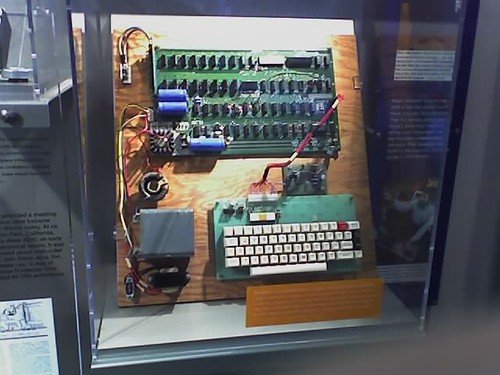
Original Apple 1
Another cellphone camera picture taken at the Computer History Museum in Mountain View. If you are ever in the Bay Area make sure you visit this great exhibition. They also have a good speaker series.

#2 Adobe Illustrator 1.0 (1626 views)
Adobe Illustrator 1.0
More views then the Apple 1 picture… Makes me proud to work at Adobe. It is amazing what a loyal community of users Adobe has in the creative community. Who knows, maybe one day my first Apollo application picture will be featured in the Computer History Museum.

#1 Girls Gone Wild (19,028 views and counting)

Girls Gone Wild
Well, what can I say… I posted this picture on Flickr with the specific purpose to get many views. A little experiment to see how many people would find and view a photo with cute girls and tag baits. Eventually I put it also into four photo pools. While I expected about 1000 views the result was astonishing. Over 19,000 views (10 times more then any other of my Flickr pictures). Also even so the photo is over 2 years old the number of views continues to increase at a steady rate. I have to admit that I even didn’t take this picture. While I was working at a trade show in Vegas my brother Thomas and his friend had fun at the Palms Hotel pool and they took the picture with my camera.

I will check back again in three years and lets see if any other of my pictures will get more views eventually. I heard that cute baby pictures are also popular ;-)
I need to update my Blog

Big news from Adobe. This will make Flex the de-facto standard for Rich Internet Applications.

read more | digg story

Well it is not quite April fools day yet, but Nat Torkington from O’Reilly has posted this hillarious entry on his blog. We all know the semantic Web is around the corner… not (watched Borat yesterday).
Thirteen years ago I started to work in the area of electronic data interchange between companies. The biggest challenge was to get an agreement on the semantics of the message (just look at the numerous ways a Name and Address Field can be qualified) and have different applications interpret the data in the same way. The UN standard EDIFACT, as complex as it is, went a long way, but then came XML which was supposed to solve everything. What a lot of people did not understand then is that XML is just syntax and the semantic problem was still not solved. Until today the electronic exchange of business data in a many to many scenario remains challenging. But I am digressing. Here are some of my favorite parts of Nat’s post:

2010: Semantic Web developers release a new XML format. This will be hailed as the final step to the completion of Web 3.0.

They’ll skip version 7, and release “Firefox X”. X will support RSS for blogs, IM, twitter, and the new communication system that flashes updates from your friends every 2 seconds in yellow on black 64pt type as you work. “Crack”, as the system will be called, will be so addictive that it drives sales of Firefox X through the roof… As the corpses stack up in city streets, the professional time-wasting class known as Knowledge Workers will have been eliminated from the world.

Ryan Stewart was the first to blog it. The Alpha version of the Adobe client runtime code named Apollo is available for public download on http://labs.adobe.com. Could Apollo ring in the beginning of a new class of desktop applications programmed with web technologies?

read more | digg story

Adobe just released on Adobe Labs a web application called myFeedz. Based on your personal profile, your tags and your reading behavior it will present you news stories based on RSS feeds and web sites which are relevant for you. It has a very slick AJAX UI. Looks like the Netflix movie suggestion feature for RSS feeds and web site. Its for free so try it now.

read more | digg story

Today Michael Arrington covers Apollo, the Adobe runtime which supports web applications on the desktop, on both TechCrunch and in an interview with Kevin Lynch on TalkCrunch. The coverage spawned a number of reactions on the web and a top position on Techmeme. While Apollo is not released yet the interest is positive and people like Alex Barnett, Ryan Stewart and Amy Bellinger predict that 2007 will be the year of Rich Internet Applications.

While the initial focus of Apollo sample apps is very consumer oriented (e.g. E-Bay client or MP3 Player) I have been contemplating for the last year how Apollo could be used as a Rich Client for Enterprise Applications. I had a number of good discussions with various people from SAP as well as SAP customers. The key capabilities enterprise users are looking for are usability, performance, offline abilities and desktop application integration. I presented my thoughts for the first time in May at the Americas SAP User Group Conference in Orlando.

Back in May the interest was fairly limited but some early adopters realized the potential impact Apollo could have on the way we interact with enterprise applications. Since then the interest has significantly increased, especially since Shai Agassi discussed SAP’s project Muse at SAPPHIRE.
Here are some use cases for Apollo:
- CRM client for Account Managers with offline support
- Client for Employee and Manager Self Services
- Dedicated client for Support Staff and Field Services (see also the recording of the SAP Flex Demo)
- Enterprise Performance Analytics Widgets

I predict that significant adoption of Rich Clients in the enterprise will follow about two years after the adoption for consumer apps. IT departments tend to be conservative and there are still a number of difficult issues to solve, incl. the security of offline content and local system access. Also the synchronization between online and offline usage is a challenging topic and it will be critical to figure out which information is stored for offline usage for a particular user.

Mike Chambers has a link to a 10 minute video interview / discussion with Christian Cantrell of the Apollo team on his Blog.
For ongoing news about RIAs and Adobe Apollo see RIApedia, the new Blog from Mike potter (Developer Relations at Adobe) and check out this cool yourminis app.

There are currently only two entries in my Upcoming.org event list, but both are very special and I am looking forward to attend them. They are also quite different, but somehow related (I cover that later).

Next week Monday I will participate in the third Web Monday Silicon Valley in Palo Alto. This informal meeting which allows participants to cover all aspects around Web 2.0 originated in Germany and is now established in the Bay Area as well. If you are interested to learn more about the Web 2.0 scene in Germany and discuss or present your ideas make sure to sign up. I attended the first meeting and presented Flex development on top of SAP. If time permits and people are interested I might even talk a little bit about Apollo and show some demos.

If you are interested in chameleons or reptiles in general you might want to visit the San Jose Reptile Show on Saturday, November 11. If our baby boy is not born by then I will certainly be there and discuss chameleon breeding with the experts. Last time when I attended the show they had an amazing variety of reptiles on the showfloor.

So how are these two events related? Well Web Monday discusses technology innovations in Germany… SuSE Linux is from Germany and has a chameleon as a logo… Chameleons are being shown at the San Jose Reptile Show… and now I feel kind of stupid for writing that. Time to go to the gym.

I am currently sitting in a session on “Building Dashboards with Flex”. Interesting stuff, but to many details for me. So here are more notes on the keynote session this morning.

Kevin is back to discuss how HTML, Flash and PDF come together on the client side, outside of the browser. Yes you have guessed it, time to talk about Apollo. Ed Rowe comes on stage to demonstrate the current status of Apollo. He describes Apollo as a cross OS runtime which enables developers to deliver Rich Internet Applications for the desktop by leveraging existing skill sets in web technologies.
He takes Sho’s browser based Music Player and runs it outside the browser in Apollo. The application can read and write files from the local disk and pull album art from the internet via web services. The cross platform story is critical to Apollo. Ed switches over to a Mac and uses the same application with exactly the same code. Nice!

The Apollo runtime sits on top of the OS (Mac, Windows, Linux in the future) and runs applications developed in Flex or HTML and can also embed PDF files. Ed shows Google Maps in Apollo. It works smooth, proving that Apollo can handle complex Ajax applications. He then brings up contact panel in Flash mashed up with Google Maps. The seamless integration of Flash and HTML rendering including transparency between the layers is impressive. Developer APIs for Apollo will be available both for Flex/Flash as well as for AJAX/JavaScript.

Here is a list of other key Apollo features:
- Local file access
- Online/offline detection
- Drag-and-drop
- Clipboard access
- Backgound windows
and many more…

Ed explained that there will be SDKs to develop Apollo applications similar to the current Flex SDK. Soon you will be able to sign up for Apollo SDK news on www.adobe.com/go/apollo.

Kevin comes back and shows some early Apollo applications. I was particular impressed by the Ebay client prototype which allows user to manage auctions. Some nice effects in there to browse auction item pictures and create pictures/videos on the fly with a webcam.
Prototype Ebay client based on Adobe Apollo

Another impressive example was a rich text editor and collaboration tool developed in Flex and deployed on Apollo. Other examples included a finance application for mortgage and loans, including PDF forms and an instant messenger for mySpace.
Wow I think I am just seeing the future of desktop applications.

Finally Kevin showed an Internet TV application developed by Adobe as a showcase for Apollo. It is driven by RSS and downloads videos to your desktop so you can watch them when you are offline. It takes advantage of the fullscreen video mode of the Flash Player 9 upgrade, also available on Adobe Labs.

I want it now!

However the biggest news was Adobe’s announcement to create an investment fund for $100 Mio. to invest in companies creating RIA’s and especially Apollo applications.

In the end a brand new Jaguar XK was hauled out, which Kevin cateorized as the largest mobile Flash device in the world. The console of the car is completely based on Flash technology.
Kevin Lynch in the new Jaguar XK with Flash based panel

I am sitting here in a crowd of a couple of thousand people enjoying a special performance of the Blue Man Group. It is 8:40am in the morning in Las Vegas and I am at the opening session of the Adobe MAX conference. When I registered last night I got a good amount of conference schwag including the special MAXUP T-Shirt for presenting today in the MAXUP track. I also like the conference bag. Unlike the typical black bags which I tend to leave at the conference, this one is actually cool and I think I can re-use it as a diaper bag :-) I will post a picture later.

Kevin Lynch kicks of the keynote and previews the upcoming Reader 8. Nice effects in there for previewing pages.

Now Shantanu takes over and talks about the Macromedia acquisition. A video of customers talking about their reaction when they learned about the acquisition highlights the excitement about this marriage. Shantanu talks about other milestones this year, including the launch of Flex 2 and Flash Player 9 as well as the announcement of Acrobat 8.

Kevin takes over and talks about Flash Player 9. Just during the last months the upgrade rate to the new player has been faster then for any previous Flash Player release. The Flash Player is really a ubiqutous virtual machine available cross-platform and cross browser. One factor for the dramatic adoption of the new Flash Player version is Flash video which has seen significant adoption over the last year from sites including MySpace, Yahoo, ABC and others. Kevin also mentions that there are now over 200,000,000 PDFs on the web.

Kevin switches gears now and brings a number of people on the stage to demo the improved Designer Developer workflows in upcoming Adobe products. It becomes very clear that Adobe is truly understanding customer needs here and a lot of the new integration features receive applause from the audience.

1st example: Designer developer workflow for HTML website development
- Start with Photoshop
- Add interactivity in Fireworks
- Finish and deploy with Dreamweaver

The website creation workflow starts often in Photoshop and not in Dreamweaver. The presenter highlights improvements in bringing up Photoshop files within Fireworks. He also demos the ability to load multiple Photoshop images into Fireworks and add common elements like a navigation layer on top of the images and then add interactivity to the navigation bar. The result can be saved as HTML. This is a great way to create quick mock-ups which you can share with end-users and clients for feedback. In the next step the project is being opened the in Dreamweaver. A highlight is the new way to copy and paste images from Photoshop to Dreamweaver, which kicks off a workflow which allows the designer to add important web properties like accessibility tags to the image.

Additionally Dreamweaver enables the developer to add AJAX features to the site with the Spry framework. Instead of coding, features like AJAX animations can be configured through wizards in Dreamweaver. The Spry Framework is posted on Adobe Labs.

2nd example: Flash Workflows with Dynamic Media
Again the process starts of in Photoshop. Some of the usability features of a future Photoshop release are being demonstrated. The demonstration on importing a Photoshop .psd file in Flash got a round of applause. The import keeps all layers intact. A lot of nice import features I do not understand, but audience seems to like it ;-) Next step is to use After Effects to apply engaging experiences to Flash. Sample shows how to use a brand new technology called “Puppet Tool” in After Effects and animate a character. Finally some more 3D animation features get added and the result is exported as Flash.

The team also demonstrated a brand new audio application (cannot remember the code name) for creating soundtracks and to incorporate audio into Flash which will be available this week on Adobe Labs.

3rd example: Designer Developer workflow with Flex
Sho Kuwamoto talks about Flex application skinning and using UI components designed with Illustrator in Flex.
He starts in Flex Builder and creates the basic application layout for an iTunes like application with multiple buttons for controlling the music and a datagrid for displaying the songs. In a future version of Illustrator the integration of symbol graphics will be better integrated with Flex. He exports the button images out of Illustrator as .swf. Then he imports the swf’s in Flex and assigns them to the generic buttons using the “Style” functionality.

Switching from the designer to the developers perspective in Flex Builder, Sho now defines the Web Service connectivity for the application. He points out the ease of coding with MXML, code hinting and code highlighting. Sho creates the whole music player application in 10 minutes… on a Mac! Yes, this is not a typo… Later this week Adobe will announce a public beta of Flex Builder for Mac. Cool! One more reason for me to switch to a MacBook.

Ben Forta enters the stage and shows new features in ColdFusion for back-end development and the Flex Builder integration with ColdFusion.

4th example: Electronic Document Workflow
Ben demonstrates PDF functions for electronic document workflow. He starts with a plain non-interactive PDF form document and imports it into the Adobe LiveCycle Designer. The new field recognition wizard in Designer 8 is impressive. Ben shows how to use the Designer to add more interactivity to the form, standard functionality available today. What is new is the cross-over between interactive PDF forms and Flex/Flash applications to interact with data. Seamless integration between a PDF version and a Flex version of the form is being worked on. He also shows the future Guide Designer in the LiveCycle Designer which supports the generation of Flex wizards based on XFA/PDF forms. A lot of exiting stuff which will bring the Flex and LiveCycle world closer together.

Need to catch my next session. More about the keynote later, including Apollo update and the $100,000,000 announcement.

I am sitting at the San Jose airport and waiting for my flight to Las Vegas. I actually just returned from the European SAP TechEd on Friday. It was a great event and we had a lot of Adobe related activities. I specifically enjoyed the SAP Developers Network day and showcasing Flex to SAP developers. Enrique Duvos, our European Flex evangelist, helped me with the sessions and I learned some more Flex Tips and Tricks. He also gave me a great presentation highlighting 10 reasons why one should use Flex to create Rich Internet Applications. I uploaded it on Slideshare, but the Adobe Myriad Pro Font got butchered in the process.

BTW Slideshare just opened to the public today (it is still in Beta), so try it out!

I also filmed some of the highlights of SDN day and SAP TechEd, but did not have a chance yet to edit and upload the video. The interest in Adobe technology was overwhelming and our booth was busy 8 hours a day. I had a good meeting with Eddy de Clercq. He created SDN World and we discussed how SDN World could be improved with Flex. I am hoping I can find a Flex engineer at MAX who is interested in this little side project. Talking about MAX, the Adobe customer conference… That’s the reason I am traveling again to Vegas (at least third time this year I think). I am very excited since this is my first MAX conference and people told me it is very energetic and lots of hands-on and ad-hoc techie stuff going on. I am particular interested in all session around Apollo (and obviously Flex). Even as an Adobe employee you sometimes learn more at a conference then back in the office. Next week I am having a workshop with SAP Research around Adobe technologies and MAX will be a good opportunity for me to get an overall update on interesting products and projects.

Also I am presenting at MAX. There will be an invitation only session (Wednesday 10:00 - 11:30am) for Adobe partners to learn more about the strategic partnership between Adobe and SAP and why this is relevant to the larger Adobe ecosystem. I am presenting together with Roman Bukary from SAP. If you are at MAX, work for an Adobe partner, but did not get an invitation please let me know and I will get you one.

I am also doing a cool Flex SAP mash-up demo as part of the MAXUP un-conference. Don’t know my time slot yet, but will update you later. It would be great to meet some readers of my Blog in person. Since I am Vegas regular, I know also a lot of good bars and restaurants :-)

Need to get into the plane now…

Update: My 15 minute presentation slot at MAXUP (5th floor of the conference center) is tomorrow (10/24) at 11:30am.

I just learned today that there will be a shadow unconference called MAXUP as part of the Adobe MAX developer conference. That’s excellent! I find these events often more useful then the “real” conference program. The SDN Day as part of SAP TechEd was a good example. Even back in the 90’s when the term “unconference” did not exist I really enjoyed technology discussions and working on ad-hoc projects at hacker meetings like the Chaos Communication Congress in Berlin.

If there are enough people who are interested I could talk about Flex integration with SAP and do some demos. Well, I hope to see you at MAXUP in Las Vegas (or next week at SDN Day and SAP TechEd in Amsterdam).

P.S.: Funny Fact - Adobe MAX will be my last conference for a while since I expect my first baby around mid of November. It is a boy and his name is Max… and no, this has nothing to do with the conference… What do you think? I am not that crazy… Well I am geeky enough however to have reserved his domain and put up a baby blog.

James Ward, an Adobe Flex evangelist, just posted a first report of his experience running Flex2 applications on the pre-beta Linux Flash player 9. Sounds very exciting and he even has a screenshot. Finally you will be able to write your Rich Internet Application once and run it consistently on Windows, Mac and Linux in IE, Firefox, Mozilla and Safari.

I have been working with JBoss on a Flex based collaboration client and the results have been stunning. It’s beautiful, extremely fast, and as soon as Flash Player 9 on Linux debuts it will work the same on any OS or browser, without any “if IE” workarounds! When Apollo is available this will get even more interesting since we can take the same collaboration client application and run it offline, without the browser!

cayambe.com » Blog Archive » Flex 2 Apps on Linux!!!

Congratulations to my friends Rashmi and Jonathan on officially launching SlideShare and being immediately covered by TechCrunch and others. I have been an early Beta user of SlideShare and was especially intrigued by the ease of use of the service. It allows you to upload PowerPoint presentations, tag and share them with other users, either on the SlideShare site or via your own Website or Blog. In true Web 2.0 fashion Jonathan decided to release early (and hopefully often) so the current functionality provides just the basic features, while I bet that we will see many enhancements based on user feedback over the coming months.

I uploaded my slide deck on “Enhancing the Usability of SAP Applications Using a Rich Client” four days ago and it is right now the most popular deck with 120 views… yeah, my 5 minutes of fame have finally arrived :-) And even better now you can view the slides right here as well…

I think an important decision was to use the Amazon S3 service to handle the storage of the actual content. The instant availability of high bandwidth and storage via web services really changes the game for every company in the Web 2.0 field. Remember your typical Web 2.0 announcements which got covered on TechCrunch or Digged? You try to reach the site/content and it is slow or not available at all due to the spike in demand. With services like S3 this is no longer the case and it gives a start-up the same scalability like Amazon.

I have a couple of enhancement ideas for SlideShare as well…
1) Be able to view/browse slideshows on SlideShare without logging in. Only uploading should require a user account (similar to Flickr)
2) Be able to upload slides with audio and/or add audio to slides using SlideShare
3) Handle animations in the Powerpoint slides
4) There are some font issues which you can see on my slides (e.g. 4 and 5)
5) A lot of people commented that slides cannot be set private to specific user groups. I am personally not very interested in that feature since my slides are used for evangelizing technology and I want to reach as many people as possible.

I have also some related ideas which I am refining right now. But thats something I want to first discuss with Jon over a glass of beer.

Keep up the good work!

A while ago I signed up for Ning a service which lets you create your own Social Website without coding (well you can even code PHP if you want to). I never used it until I received an email tonight, that Ning has added new templates which make the creation of your own site easier. They added Ning Videos, Ning Photos and Ning Group.

To test drive the service I created a new photo site called “Las Vegas Parties“… I felt I have some expertise in this area ;-)

I like the wizard driven approach of creating the site. However adding the actual photos seemed tedious (no client uploader utility). I would have liked to just add my pictures from Flickr, but there was no obvious way to do that. Just to get the site started I uploaded some party pics from Tao into a new album. It seems that only I can post into that album, while I would expect that also other users can upload their Tao pictures into the same album. I probably need to dive deper into it.

I have also a great idea about creating a custom Ning group. More about that later, but let me know if you know other services you like/use which provide an easy, but yet feature rich way to maintain a virtual group of people (discussion board, photo sharing, calendar, user management, etc.).

Update:

Om Malik is fairly upbeat on the Ning enhancements

In short, it allows niche sites to cheaply add community tools to their existing web presence. This could be a precursor to a fund raising effort by the company that has so far been privately funded by Marc Andreessen.

John Battelle is also upbeat, but points out that Ning might try to boil the ocean…

In short, it’s not about one company owning a space - video, or social networking, or photo sharing. It’s about letting anyone have these kinds of services. That’s biting off a hell of a lot, and there is much to prove, but if the planets align, I have to say, it’s an impressive play.

Now it is official: Flickr allows you to put geographical tags on your pictures and browse them by location on Yahoo! Maps. I just tried it and Flickr actually recognized that some of my pictures were already geotagged by Plazes and automatically imported the geographic information. Neat!

I attended the first Web Montag in Mountain View in June and really enjoyed the opportunity to exchange various technology ideas. I presented a Flex 2 application integrated with SAP web services. About half of the attendees were Germans or Swiss and the others Americans with an interest in Germany. I was really intrigued by the presentation of Stefan and Felix who build Plazes, a web site which keeps track where you last logged on to the Internet. I became addicted and use it a lot (as you can see from my Plazes batch on top of the Blog).

David Hornik (VentureBlog), just wrote about Entrepreneurship In Europe. I agree with him that it is even harder to build a successful start-up in Europe. What is important to understand however is that Europe is not one country. Each individual European country continues to have its own culture and therefore also deals differently with technology and start-up businesses. A lot of activity is actually going on in Ireland, but as you can tell from initiatives like the interest in Web Montags all over Germany other countries have grass roots efforts as well. As we discussed at Web Montag a major hurdle of starting a company in Germany is the fact that in case you fail (which is very likely) your reputation can be ruined. Therefore fewer entrepreneurs take the risk of starting a company. Interestingly several Silicon Valley executives came to the same conclusion in a meeting with British Prime Minister Tony Blair.

The 2nd Web Montag in Silicon Valley will take place on August 14. Now you have the opportunity to join the discussion and help foster American German technology relationships around Web 2.0. I hope Shel Israel reads this and has a chance to attend since he is doing research for his next book “Global Neighborhoods”. Unfortunately I cannot attend since I will be in Los Angeles for a short vacation. But I certainly will come again next time.

Kevin Lynch recently disucssed the Adobe Engagement Platform with Knowledge@Wharton

And that is the core of what we’re trying to enable people to do — engage effectively. That’s what bringing our software together is about. All of our tools, our servers, our client [software], and [our developer] frameworks — all that stuff is to help people engage better.

And so we call that the “Engagement Platform.” It’s basically the collection of software you can use to create these experiences and engage people.

Kevin Lynch on Adobe’s Plans for a New Generation of Software - Knowledge@Wharton

technorati tags:, ,

Alltop, all the cool kids (and me)
www.flickr.com
Zatoichi's photos More of Zatoichi's photos

Categories